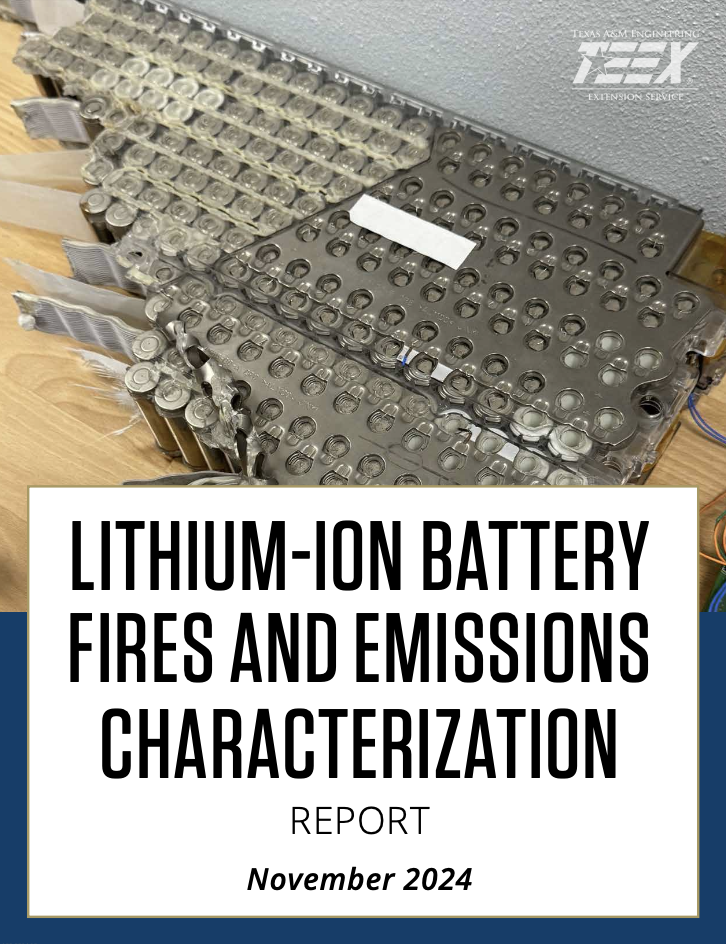
Lithium-Ion Battery Fire Emissions Study
Attachment and summary of a study on li-ion battery fire emissions and turn-out gear (bunker) gear contamination and cleaning.
Overview
In May 2024, Texas A&M Engineering Extension Service (TEEX), along with its research partners, conducted a series of tests to determine the contamination produced by lithium-ion (Li-ion) batteries and its impact on first responders and their personal protective equipment (PPE).
Researchers also measured the effectiveness of different cleaning methods. All tests were conducted at the Southwest Research Institute (SwRI) facility in San Antonio, Texas, under the direction of Dr. Imad Khalek, Institute Engineer and Principal Investigator. [Lithium-Ion Battery Fires and Emissions Characterization Report November 2024]
Summary
Li-ion battery thermal runaway fires release highly toxic gases and particles that exceed the Occupational Safety and Health Administration (OSHA)-permissible exposure limits (PEL). During the tests, contamination was extremely high. It ranged from 12,000 to 17,000 times more than the United States Environmental Protection Agency (EPA) ambient standard of 9 μg/m3 for Particulate Matter (PM). Emissions were dominated by metallic particles and, to a lesser extent, soot.
The study also tested PPE cleaning for structural fire structural protective clothing (SFPC) also known as turn-out gear or bunker gear. The results are quoted below:
- High concentrations of lithium, nickel, cobalt, manganese and copper were detected during each Li-ion thermal runaway event, with lithium being the most dominant. The traditional NFPA 1851 water-based cleaning of the PPE removed about 99.2% of all the metallic particles in the gear; liquid CO2 cleaning removed 99.8% of all the metallic particles.
- Some of the SVOCs remained in the gear after water-based cleaning. Cleaning efficiencies ranged from 21% to 92%. Liquid CO2-based cleaning was highly effective, with many SVOCs being undetected in the cleaned gear.
- Several metals, such as cobalt, manganese and lithium, remained in the gear regardless of the cleaning method used.
Attachments
Lithium-Ion Battery Fire Emissions Characterization Study
by TEEX
Li-Ion Fire Emissions Study by TEEX.pdf