
Potassium Iodide (KI) Paper
Overview of KI paper process, advantages and limitations of use, and operational tips and tricks for employment.
How Potassium Iodide (KI) Paper Works
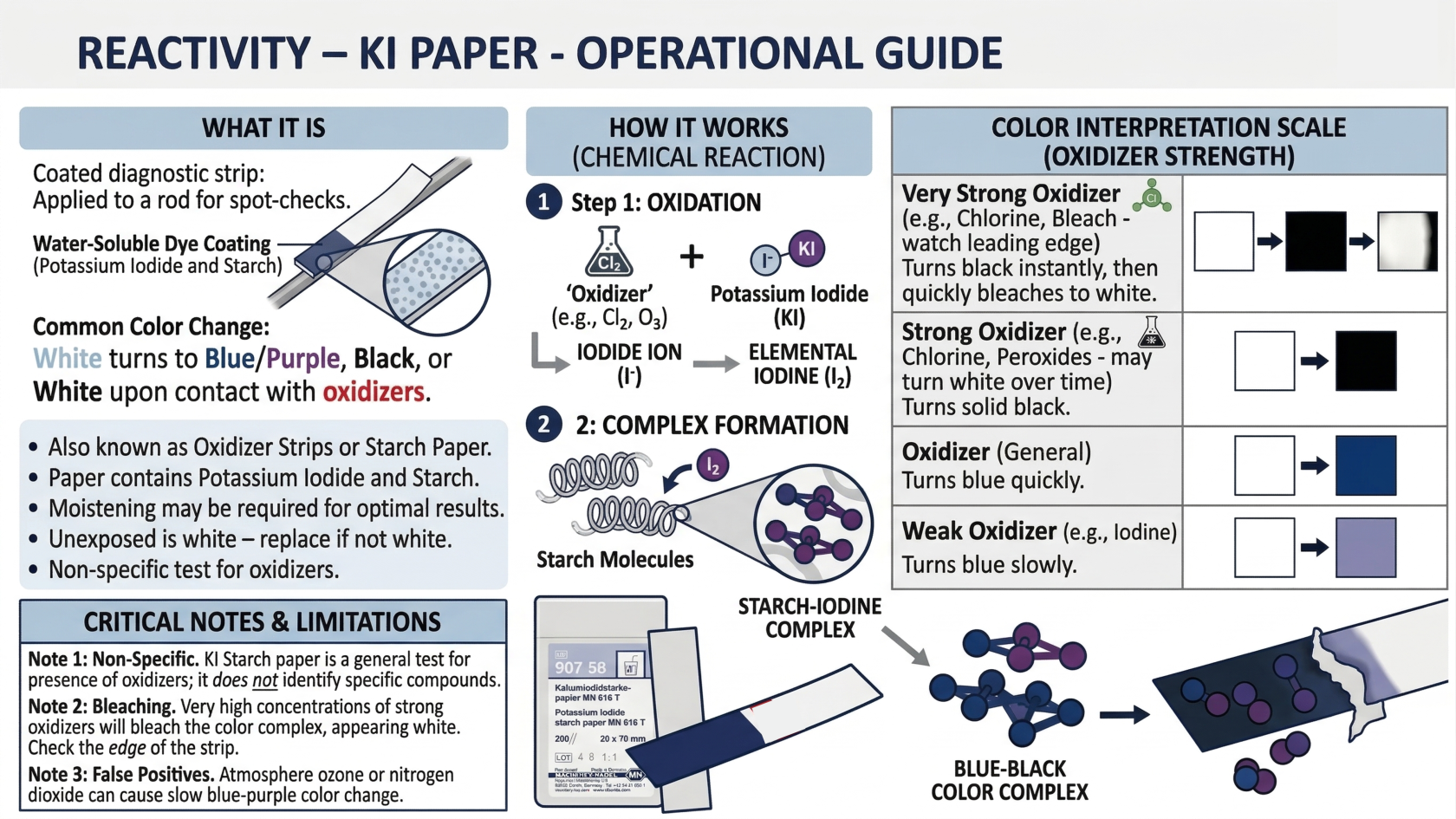
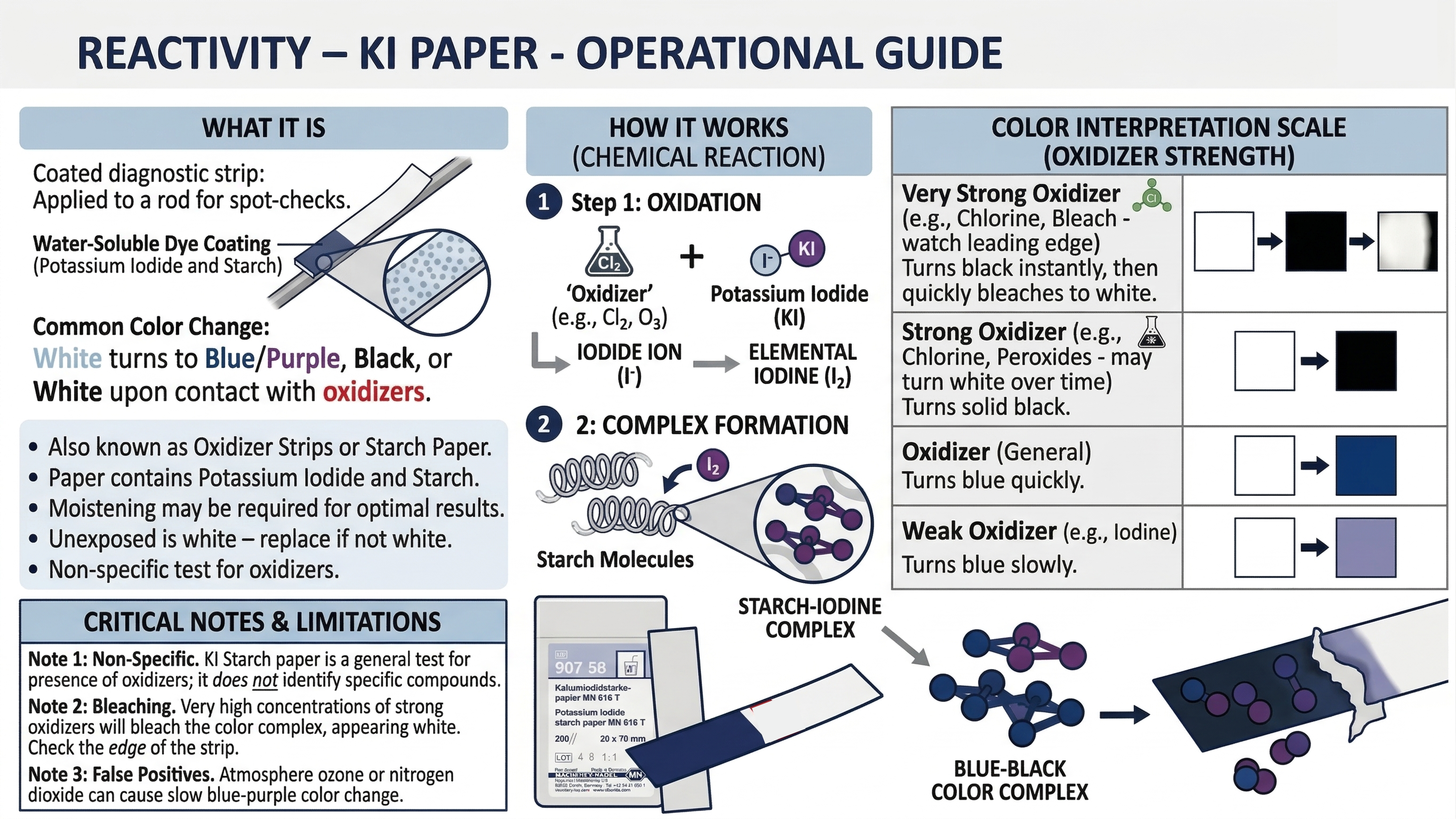
Potassium Iodide (KI) starch paper is a classic chemical indicator strip used to detect the presence of oxidizing agents (such as chlorine, fluorine, bromine, ozone, hydrogen peroxide, and nitrogen dioxide). It operates on a straightforward oxidation-reduction (redox) reaction that couples with a visual starch-iodine complex matrix.
The underlying chemical sequence follows these steps:
-
Oxidation: The test paper is pre-impregnated with potassium iodide and starch. When an oxidizing agent contacts the paper, it oxidizes the colorless iodide ions (I-) into elemental iodine (I2):

-
Complexation: The newly formed elemental iodine (I2) immediately reacts with the triiodide ions present to form a polyiodide chain, which binds inside the helical structure of the starch molecules embedded in the paper.
-
Colorimetric Shift: This starch-iodine inclusion complex alters the light absorption properties of the matrix, shifting the paper from white to a distinctive deep blue, purple, or near-black color. The intensity of the color shift provides a rough, qualitative indication of the concentration and strength of the oxidizer.

Advantages
-
Immediate Threat Triage: The color change is exceptionally rapid, often occurring within 1 to 2 seconds of contact with a strong oxidizer. This gives field teams instant confirmation of an oxidizing hazard.
-
Zero Logistics or Power: It requires no batteries, warm-up times, calibration curves, or electronic maintenance. It can sit in a pocket kit indefinitely and function perfectly in extreme temperatures or high electromagnetic fields.
-
High Sensitivity to Strong Halogens: KI starch paper is incredibly sensitive to common tactical and industrial inhalation hazards like chlorine gas (Cl2) and fluorine gas (F2). It can flash dark purple at concentrations well below those immediately dangerous to life and health (IDLH).
-
Low Cost and Scalability: Because it is highly inexpensive to manufacture, massive quantities of test strips can be deployed across a large team or used as a disposable "first-look" tool to screen unknown containers before bringing out expensive electronic instrumentation.
Limitations
-
Severe Lack of Specificity: KI paper is a generic hazard-class indicator. It tells you that an oxidizing material is present, but it cannot identify the specific chemical. It will turn the exact same shade of purple whether it is hit by hazardous industrial chlorine gas, ozone from a lightning strike, or consumer-grade hydrogen peroxide.
-
False Negatives from Weak Oxidizers or Acidity: While highly responsive to strong oxidizers, weaker oxidizing agents may fail to convert the iodide ions fast enough to trigger a distinct color change in the field, leading to a false sense of security.
-
The "Bleaching" Effect: If the paper is exposed to an extremely high concentration of a strong oxidizer (such as concentrated liquid bleach or pure chlorine gas), the chemical can over-oxidize and permanently destroy the starch matrix or bleach the iodine molecules. When this happens, the paper may flash purple for a microsecond and then turn completely white, which an untrained responder might mistake for a negative result.
-
Moisture Dependency: For gas-phase detection, the paper must be slightly dampened with distilled water prior to exposure. The water acts as a solvent medium that allows gaseous molecules to dissolve and react with the potassium iodide ions. If the paper is bone dry, its sensitivity to vapors drops drastically.
-
Non-Quantifiable Data: KI paper provides purely qualitative (Yes/No) data. It cannot tell a responder the exact parts-per-million (ppm) concentration of a gas or verify if an atmosphere has dropped below regulatory exposure limits.
Operational Tips
Always Pre-Dampen the Paper for Vapor Testing
If you are using KI paper to detect gases or vapors (such as suspected chlorine or ozone clouds), the paper must be slightly moistened with distilled water first.
- The Reason: Gaseous oxidizers cannot react efficiently with a completely dry chemical substrate. The water layer acts as a solvent medium, allowing the gas molecules to dissolve and undergo the necessary oxidation-reduction reaction with the iodide ions.
-
Field Tip: Do not soak the paper to the point of dripping, as this can wash away or dilute the pre-impregnated starch-iodide chemistry. A quick mist or dip is sufficient.
Watch for the "Flash and Bleach" Phenomenon
When exposed to extremely high, concentrated streams of strong oxidizers (like pure chlorine gas or concentrated liquid pool chemicals), the paper may rapidly oxidize past the blue-black stage, completely destroying the starch matrix or converting the iodine into a colorless iodate form.
-
The Danger: The paper will turn dark purple for a split second and then instantly turn completely white. An inattentive responder might look down, see a white strip, and erroneously declare the area safe.
-
Field Tip: Keep your eyes fixed on the paper during the physical transition into the hotspot, rather than looking at it only after exposure. If it flashes and goes white, you are dealing with a massive concentration.
Establish a Baseline (The Two-Strip Rule)
Because KI paper reacts to a wide variety of ambient atmospheric oxidizers—including background ozone on hot, sunny days or trace fumes from nearby running apparatus engines—interpreting a faint color shift can be ambiguous.
-
Field Tip: Always use the "two-strip method" when approaching an exclusion zone. Keep one moistened KI strip sealed in a clean Ziploc bag or held back in the cold zone as your reference control. Bring the second strip into the hot zone. Compare the two side-by-side to verify if a faint purple hue is a true positive or just environmental background noise.
Read the Reaction Immediately
The colorimetric shift on a KI strip is not permanent. Once the elemental iodine is formed, it is highly volatile and will slowly sublimate (evaporate) into the air, causing the dark blue-black color to fade back to a faint brown or off-white over time.
-
Field Tip: Document and record the color change within the first 10 to 30 seconds of exposure. Do not trust a strip that has been sitting out on a sample table or dashboard for 10 minutes.
Know the Cross-Contamination Hazards
KI paper is completely non-specific. It detects the hazard class (oxidizers), not a specific chemical.
-
Field Tip: Be aware of what else is in your operating environment. Common field contaminants like nitrous oxides (NOx) from diesel exhaust, household bleach vapors used in decontamination lines, or even strong sunlight (UV radiation) over extended periods can cause the paper to turn purple, mimicking a hazardous industrial leak.
Using KI Paper to Monitor for Chlorine & Chlorine Solutions
Liquid-Phase Concentrations (Solutions/Aqueous)
When dipping KI paper directly into a liquid sample (e.g., runoff, sampled industrial waste, or unknown container contents), the concentration limits are highly defined:
-
Lower Limit of Detection (The Minimum): 5 to 10 ppm (mg/L). At this low concentration, a moistened strip will begin to exhibit a faint, light-blue or slate-grey tint.
-
Optimal Range (Clean Colorimetric Scale): 10 to 200 ppm. As concentrations climb through this zone, the color transformation occurs almost instantly (within 1 to 2 seconds), transitioning from a clear dark blue into a deep royal purple.
-
Upper Limit / Saturation Point: 400 to 450 ppm. At these levels, the paper hits its maximum color density, appearing near-black.
-
The Bleaching Threshold: >500 ppm. Exceeding this concentration brings you into the "flash and bleach" zone. The excess chlorine over-oxidizes the newly formed iodine and strips the starch matrix, causing the paper to flash purple for a fraction of a second before turning completely white.
Gas-Phase Concentrations (Atmospheric Vapors)
When using a pre-dampened KI strip to detect airborne chlorine gas (Cl2), the conversion behaves differently because the gas must dissolve into the paper's moisture layer. In terms of atmospheric fractions:
-
Detection Threshold: A properly moistened KI strip will begin to turn light blue/brown at around 0.5 to 1 ppm of chlorine vapor in the air.
-
The Life Safety Baseline: For context, the OSHA Permissible Exposure Limit (PEL) for chlorine is 1 ppm (as a ceiling limit), and the IDLH (Immediately Dangerous to Life or Health) threshold is 10 ppm}. Because the paper visibly reacts around 1 ppm, it will reliably turn deep purple/black before or immediately upon entering an IDLH atmosphere.
-
High-Concentration Gas Plumes: If exposed directly to a high-concentration vapor cloud emanating from a leaking cylinder or valve (where local air concentrations can easily exceed hundreds of ppm), the paper will immediately undergo the "flash and bleach" phenomenon.
| Chlorine Gas Concentration | Expected KI Paper Reaction |
Operational Context
|
| <0.5 ppm | No visible change |
Below standard field detection limits.
|
| 0.5 to 1 ppm | Faint blue, grey, or light tan tint |
Approaching the regulatory exposure limit.
|
| 1 to 10 ppm | Rapid transition to dark blue / purple |
Clear indicator of an active leak; entering IDLH territory.
|
| >50 ppm | Instant dark purple, potential spotting |
Severe atmospheric hazard.
|
| Massive Concentrations | Flashes purple instantly, then turns white |
Direct path of a major plume; over-oxidation/bleaching has occurred.
|
Using KI Paper to Minimize Raman and FTIR Explosion Risk
KI paper serves as a vital safety filter, analytical validator, and triage tool when handling unknown materials. Strong oxidizing agents can react violently when subjected to external energy sources or when forced into contact with the delicate sampling interfaces of electronic meters.
Running a quick, 2-second KI paper test before analyzing an unknown solid or liquid warns the responder immediately if the sample is a powerful oxidizer. If the paper flashes deep purple or blacks out, the team knows to modify their testing protocol
Raman spectroscopy operates by focusing a high-energy laser directly onto an unknown sample. If you place a sensitive, highly concentrated oxidizer (like a concentrated peroxide, chlorate, or perchlorate) under a Raman laser, the thermal energy can initiate a localized flash, deflagration, or micro-explosion.
An ATR-FTIR utilizes a high-pressure mechanical clamp—commonly called an anvil or pressure tower—to physically crush an unknown solid sample down onto an internal optical crystal (typically diamond). This mechanical configuration introduces three distinct hazard vectors when handling an uncharacterized material: high localized pressure (often exceeding 10,000 psi), friction and shear forces, and thermal energy.
The intense compressive force and shear friction of the anvil on an FTIR can act as an initiation source, providing the activating energy required to trigger a rapid redox reaction. Because the sample is tightly confined between a solid metal anvil and a rigid diamond crystal, any sudden chemical reaction instantly transforms into a high-velocity deflagration or micro-detonation directly on the sampling interface.