
Ammonia Refrigeration System Pipe Colors and Markings
Overview
Ammonia refrigeration systems may use a combination of pipe paint colors and marking labels to identify the ammonia phase (liquid/gas), pressure, temperature, purpose of the pipe, and flow direction.
The exact color coding and marking may vary based on the age of the refrigeration system and the standards in place at the time.
Pipe Marking Standards
International Institute of Ammonia Refrigeration (IIAR) Bulletin No. 114 defineshistorically defined the pipe marking standard for ammonia refrigeration systems,systems. building onIn the2021 generalIIAR requirementsbulletin 114 was incorporated into IIAR Standard 2: American National Standard for Safe
Design of ASMEClosed-Circuit A13.1Ammonia Scheme for the Identification of PipingRefrigeration Systems as appendix Q. (IIAR Bulletin 114 was previously referred to as bulletin 14).
ASME standard ASME A13.1 Scheme for the Identification of Piping Systems defined a pipe color coding and marking for all industries. IIAR appendix Q was updated to to align and build on ASME A13.1.
The exact labeling and color coding of ammonia piping and system components may vary, including changes based on when the system, or portion of a system was installed. Always verify with the ammonia system owner/operator.
On-Site Color Code Chart
IIAR appendix Q states:
“A reference chart that fully explains the ammonia refrigeration piping and component identification markers, including the approved abbreviations, should be placed in areas that are conspicuous to operating personnel. Regardless of the piping color scheme selected, a legend or key to the meaning of the colors should be posted in a conspicuous area. The reference chart, legend, or key should be made of durable material that will remain legible.”
Ammonia Specific Pipe Colors (Current and Legacy)
Current Pipe Colors
See Pipe Color Coding Scheme (ASEM A13.1) Page
Legacy Ammonia Pipe Colors
Some ammonia systems may continue to use Orange andfor Yellow pipes forAmmonia liquid and vapor.Yellow for Ammonia vapor through out the facility. Additional legacy colors may be used only in the ammonia refrigeration mechanical room.
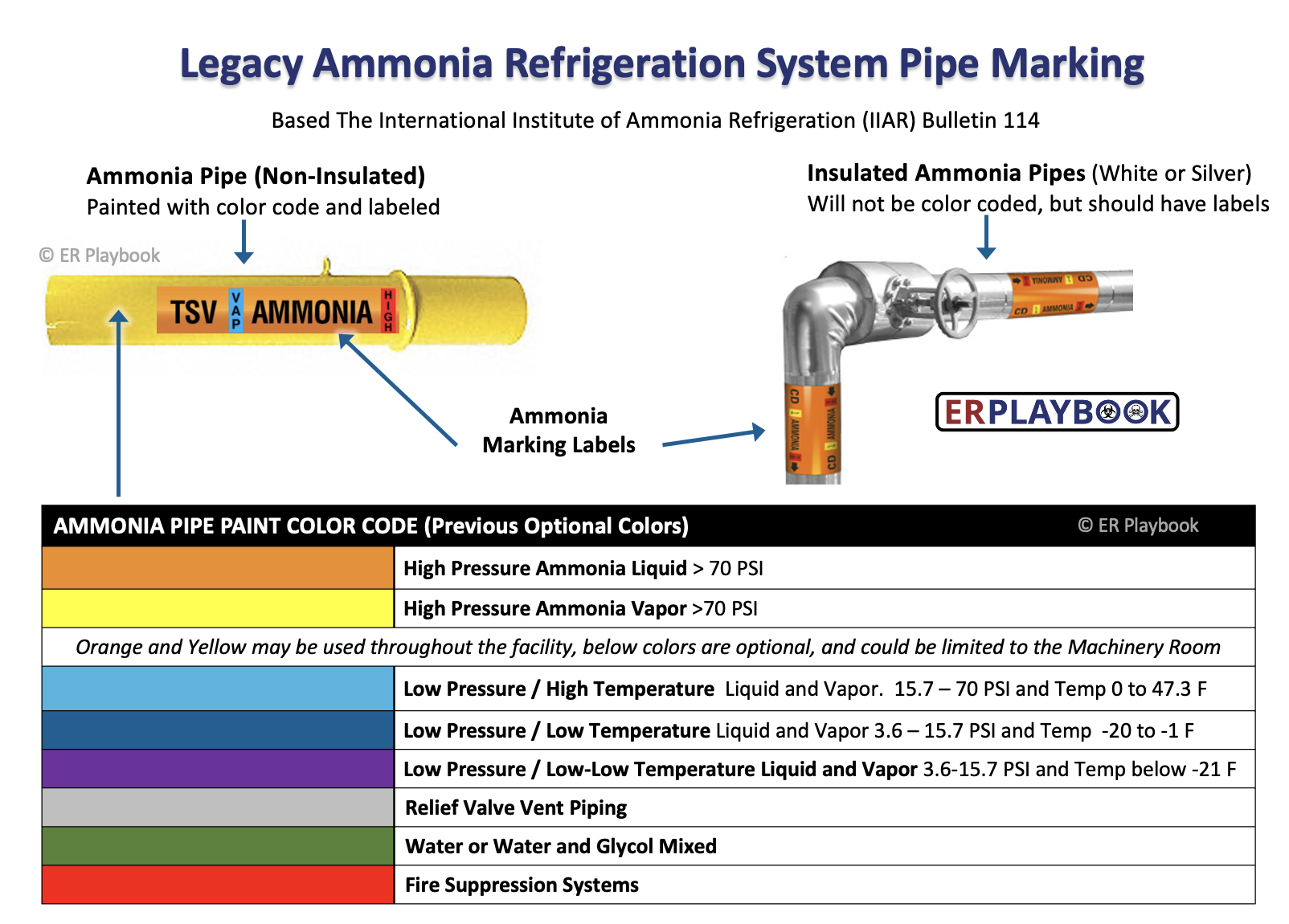
PHOTO: Legacy Ammonia refrigeration system pipe colors.
See Pipe Color Coding Scheme (ASEM A13.1) Page
OlderLegacy Ammonia Pipe Color Codes Prior to ASME A13.1 Alignment
- High Pressure Liquid: Orange (Pantone 152C)
- High Pressure Vapor: Yellow (Pantone 109C)
- Low Pressure / High Temp (Liquid & Vapor): Light Blue (Pantone 298C)
- Low Pressure / Low Temp (Liquid & Vapor): Dark Blue (Pantone 3015C)
- Low Pressure / Low-Low Temp (Liquid & Vapor): Purple (Pantone 2617C)
- Relief Vent Piping: Gray
- Water / Glycol: Green
Ammonia Pipe Markers (Labels)
Ammonia pipe markers will contain five sections of information including:
- Abbreviation Section: Printed in black
- Physical State Section: Either LIQUID or VAPOR
Printed in yellow for Liquid and sky blue for Vapor - Marker Body: Body color to be Safety Orange and contain the refrigerant "AMMONIA" printed in black
- Pressure Level Section: Either LOW or HIGH.
Pressure in excess of 70 psig will be considered to be high pressure and printed in black letters on a red band.
Pressure equal to or less than 70 psig will be considered to be low pressure and printed in black on a green band. - Directional Arrow: Detachable arrow printed in black.
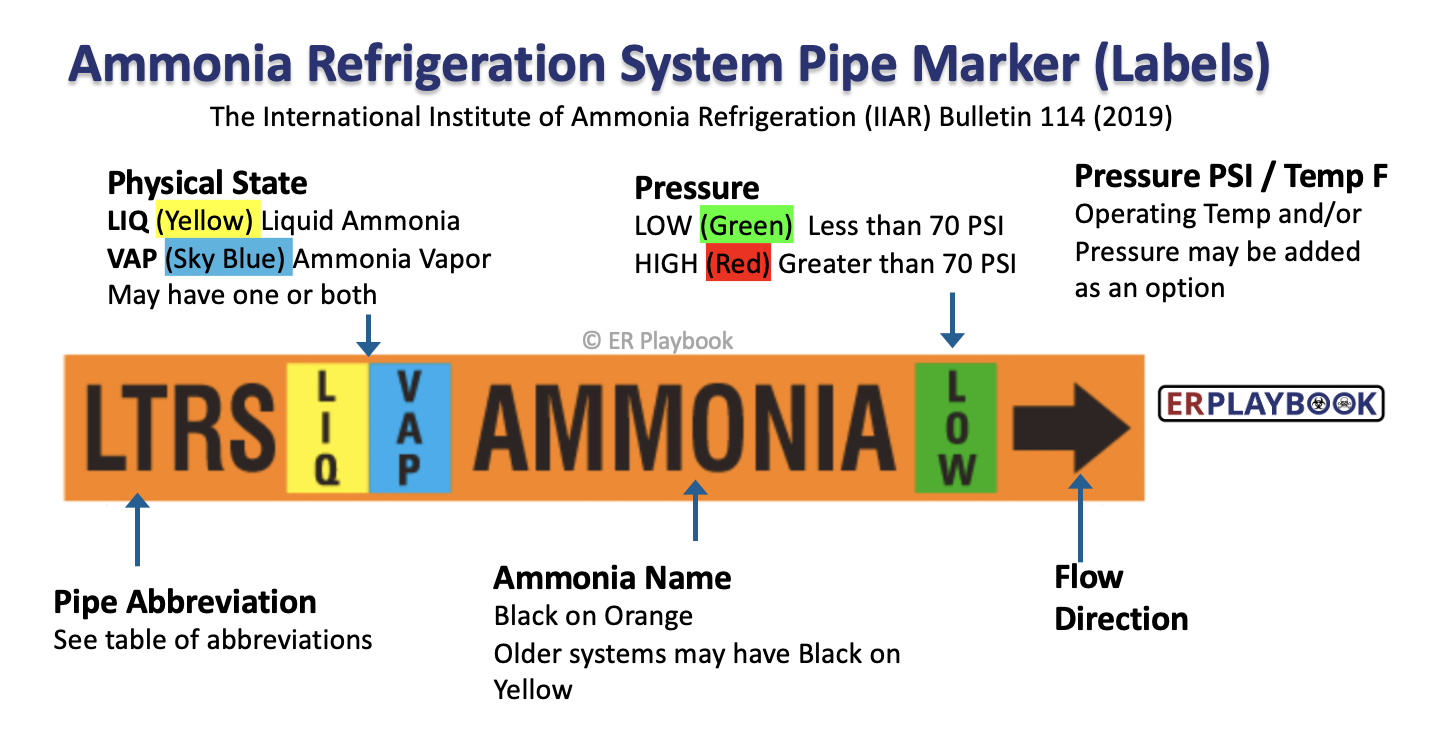
PHOTO: Diagram of an ammonia pipe label including the product/contents name, physical state, pressure, pipe abbreviation, low/high pressure destination, and direction of flow arrow. The detailed tempature and pressure may be included as optional information.
Pipe Marker Label Abbreviations
International Institute of Ammonia Refrigeration (IIAR) Bulletin No. 114 includes 31 approved abbreviations for ammonia pipe markers. The table below lists the abbreviations.
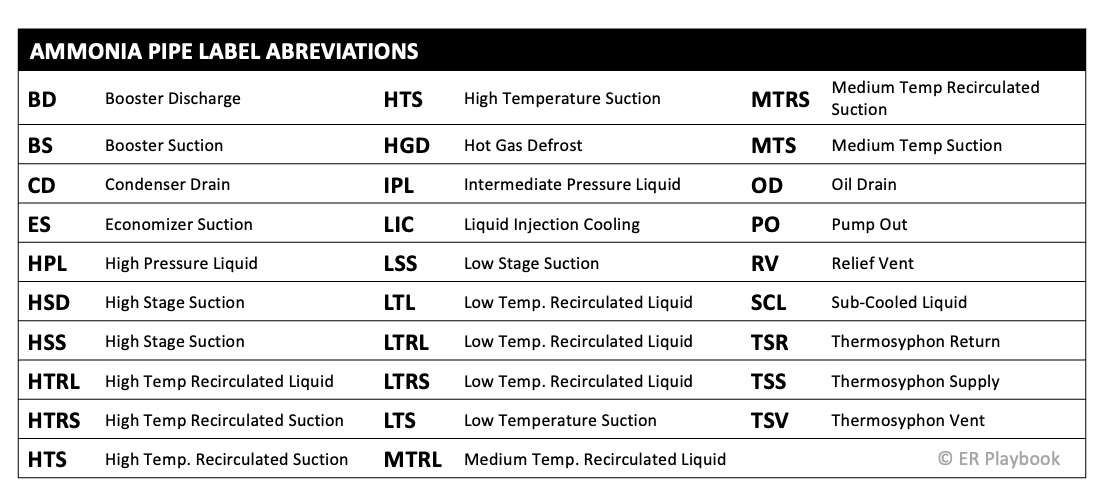
Table: List of abbreviations used in IIAR bulletin 114. Copyright ER Playbook.
Ammonia Refrigeration System Components / Equipment
Ammonia refrigeration system vessels and major components should be labeled as follows:
- Background: Safety orange with black lettering.
- Dimensions: Typically 3.5 inches wide by a length proportional to the equipment name.
- Text Size: Equipment names should be feature lettering 2.5 inches high.
- Content: Identifies the specific vessel or component name (e.g., "RECEIVER")
Prior to March 2014, IIAR Bulletin No. 114 recommended SAFETY YELLOW as the background color for component markers.
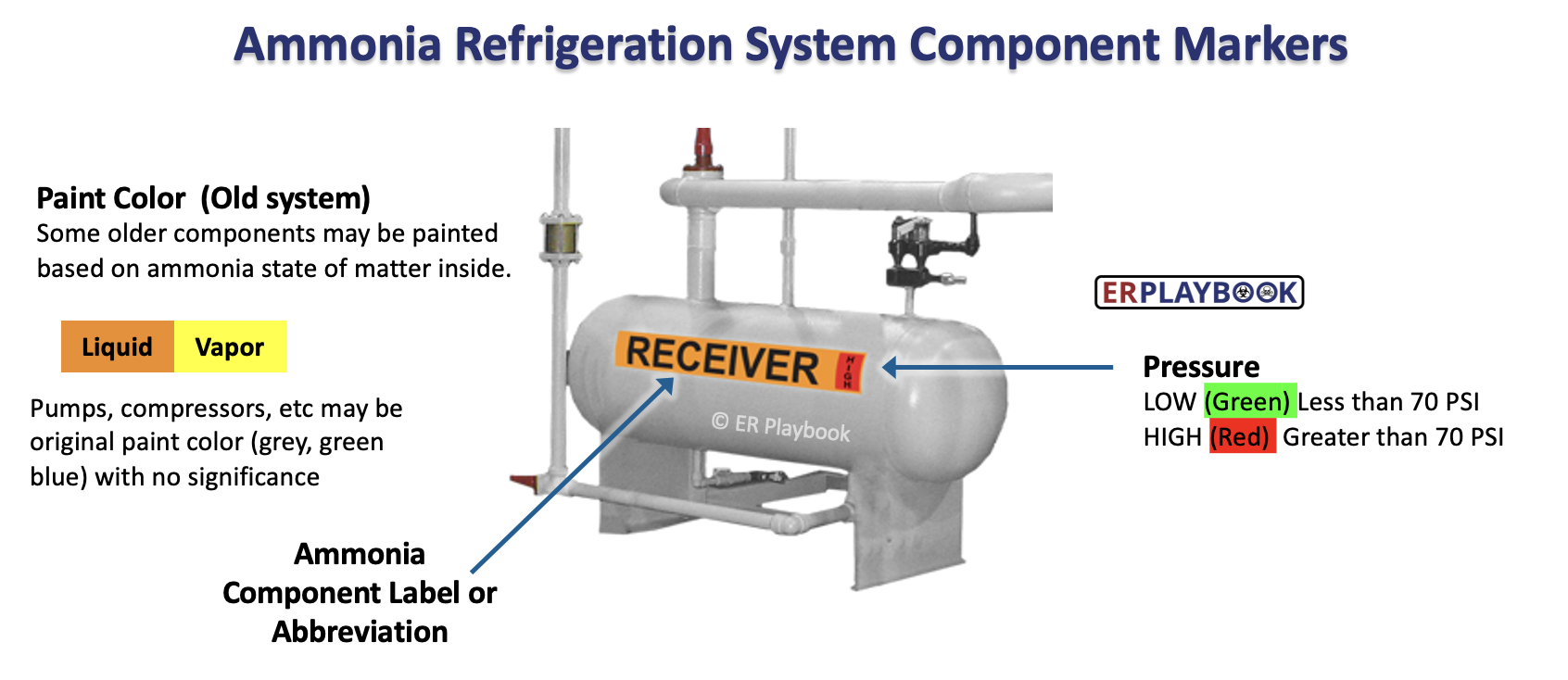
PHOTO: Diagram of an high pressure ammonia received vessel labeled in accordance with IIAR bulletin 114. Ammonia refrigeration system components or equipment may be painted a non-significant color such as grey or green, or they may be color coded as orange for liquid ammonia or yellow for ammonia vapor. Copyright ER Playbook.
Ammonia System Component/Equipment Abbreviations
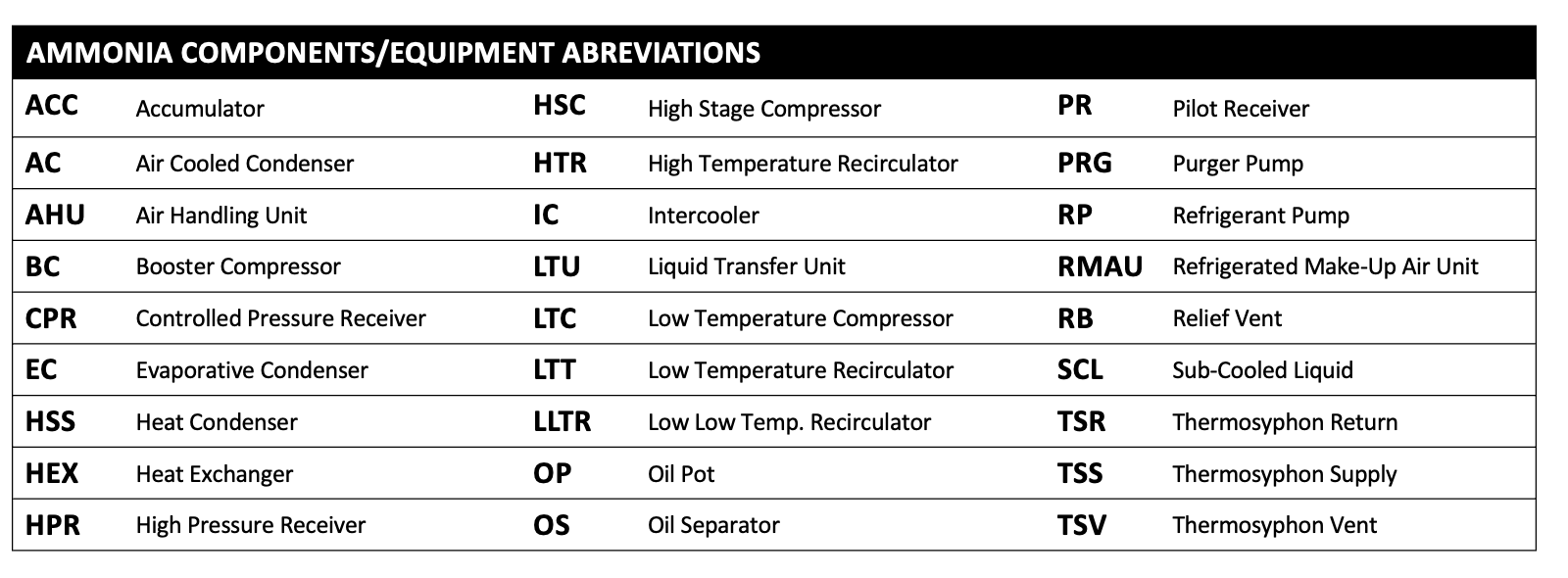
Table: List of abbreviations used in IIAR bulletin 114. Copyright ER Playbook.